• Decluttering Update: The Final Countdown, Vinted Slumps and Moving Realities

    It’s hard to believe my last decluttering update was back on August 21st. Since then, a lot has happened behind the scenes, both in my Vinted account and in real life.If you’ve been following my No Buy Year journey, you know that letting go of physical clutter has been just as important as breaking my shopping habits. Over last 6 years I have accumulated so many things it was overwhelming to even think about packing it up. I’ve sold so many unopened crafting supplies that made me feel guilty about how bad my shopping and holding onto “usefulness” was.

    Today, I’m giving you an honest look at where things stand as we enter the home stretch of clearing out our apartment.

    The Vinted Reality Check: Why Sales Have Slowed Down

    Let’s talk numbers first. At my last check-in, I was celebrating 113 items sold. Looking at my profile dashboard now, that total has grown to 220 items sold. This means that I have found a new home for 107 items in 54 days. However, if you’ve noticed a slowdown lately, you aren’t imagining things. Sales have significantly dipped over the past few weeks. At first, it made me second guess myself, but the logic is pretty clear: I’ve already sold the “hook” items.
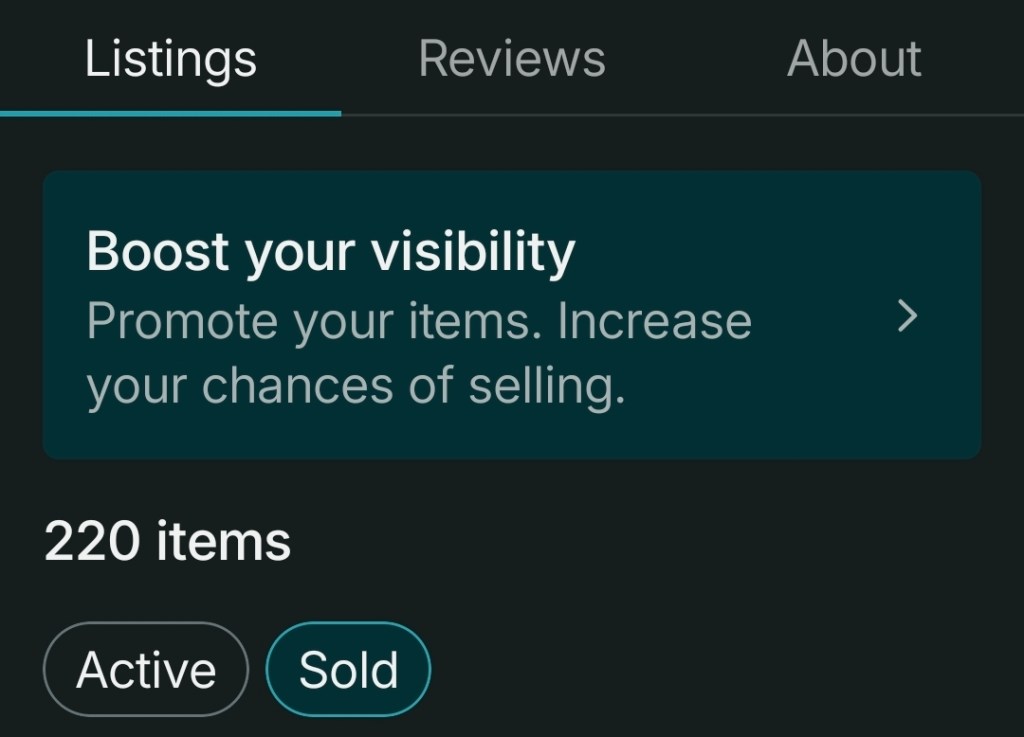
    The most attractive, high demand pieces – the ones that brought the bulk of the traffic and views to my Vinted profile in the first place – are at their new homes. What’s left are the quieter items. I’m also not listing as much as I used to at the beginning of this declutter. I used to list at least one item per day, which is good for Vinted’s algorithm. Now I list maybe one item per week, if I stumble upon something that I want to part my ways with. This has an impact on how often my other items are being shown to people browsing to buy.

    In the past many people were advising to re-list the items that haven’t sold. Take new pictures and tweak the description to boost it in the algorithm as a new product – I wouldn’t do that. It is against Vinted TOS and the site is run mostly by automated AI bots that can figure out if you delete and re-upload the items.

    I am still getting the occasional sale, which is great, but the golden rush of daily notifications has definitely calmed down.

    45 Items Left and 3 Weeks on the Clock

    Right now I have 45 items listed… and a ticking clock. As I sit here writing this post, we made a major decision today: we are going to officially cancel our rent.

    We are moving out of our current apartment, which is both exciting and terrifying at the same time. We have a standard 1-month cancellation period and a deadline for the new place, which leaves us with roughly 3 weeks to get these final 45 items out of our lives and into their new homes.

    Our game plan is set: we’re timing everything carefully so we can pack up, move out, come back to repaint the walls, and fix up any little things after the heavy furniture and boxes are gone. But that also means whatever doesn’t sell on Vinted in these next three weeks needs a plan B. Some of them are going to be donated or gifted, some things will move with us to the new home but I want to limit the amount of stuff that we take with us. Realistically we have 2 weeks to figure it out before we need to speed up packing process.
    What a No Buy Year Teaches You About Stuff

    This phase of the No Buy Year is intense. Clearing an apartment out makes you acutely aware of how much energy belongings take up. Every single item left on Vinted represents a decision: do I drop the price? Do I bundle it? Do I donate it and let go of the sunken cost?

    Moving forces me to stop putting as much value into my possessions. Even items that didn’t sell immediately suddenly look less appealing when I realize I have to pack them into a box and then unpack them .

    I’ll be back with a final update around the time of the big move to let you know how many of those 45 items found a buyer and how the packing chaos is unfolding.

    Have you ever had to do a massive declutter right before a move? How did you handle the items that didn’t sell? Let me know in the comments below!
  • Simple Pumpkin Soup Recipe – Cooking On a Budget

    The marketing teams at supermarkets are absolute masters at convenience. Pre-chopped, pre-packaged, beautifully bundled fresh meal kits are designed to catch your eye when you are tired, hungry and trying to figure out what to cook for the week.

    And even though it is a healthy and cheaper alternative to eating out, you can always make it cheaper yourself. That’s what I did last weekend.

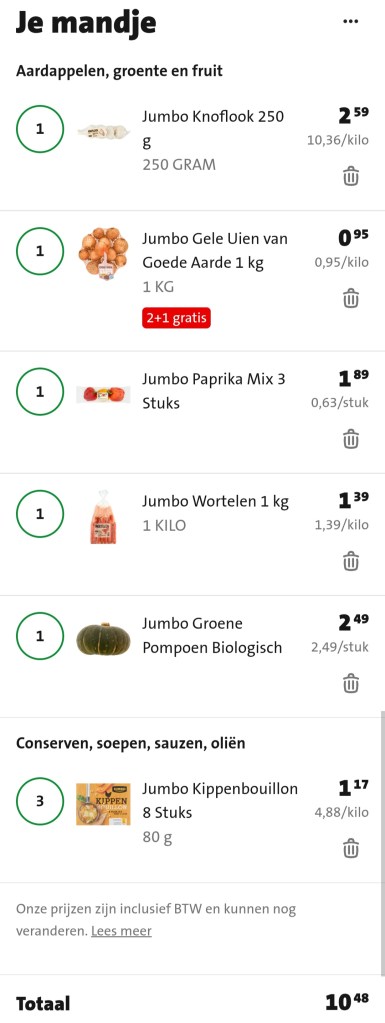
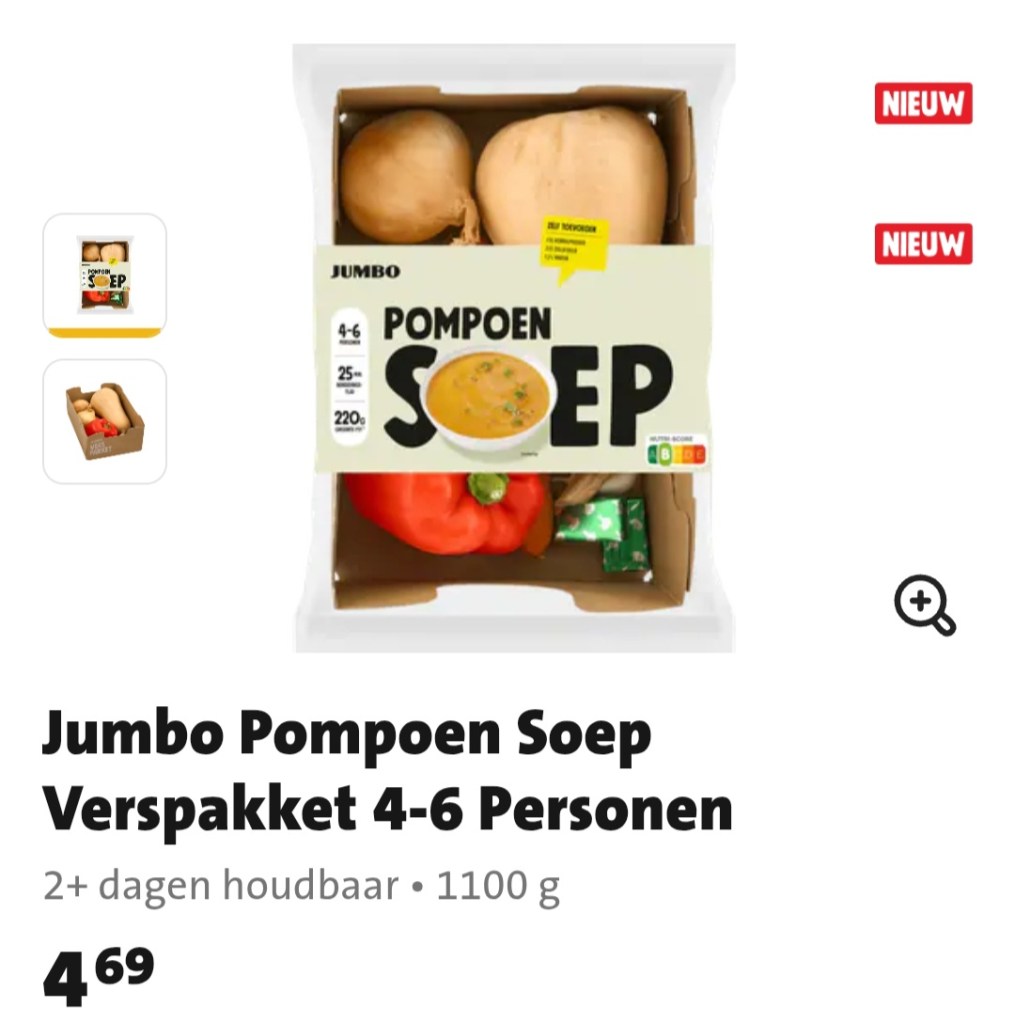
    During my routine weekly grocery run, I spotted a fresh Jumbo Pompoen Soep Verspakket priced at €4.69 for a kit meant to serve 4-6 people. It comes with (almost) everything you need for a cozy autumn pumpkin soup in one box.

    But then I paused and thought about things I already had in my kitchen – I had all, except for the pumpkin. Onions? Check. Garlic? Check. A carrot and a red pepper? Check. Bouillon cubes? Absolutely.

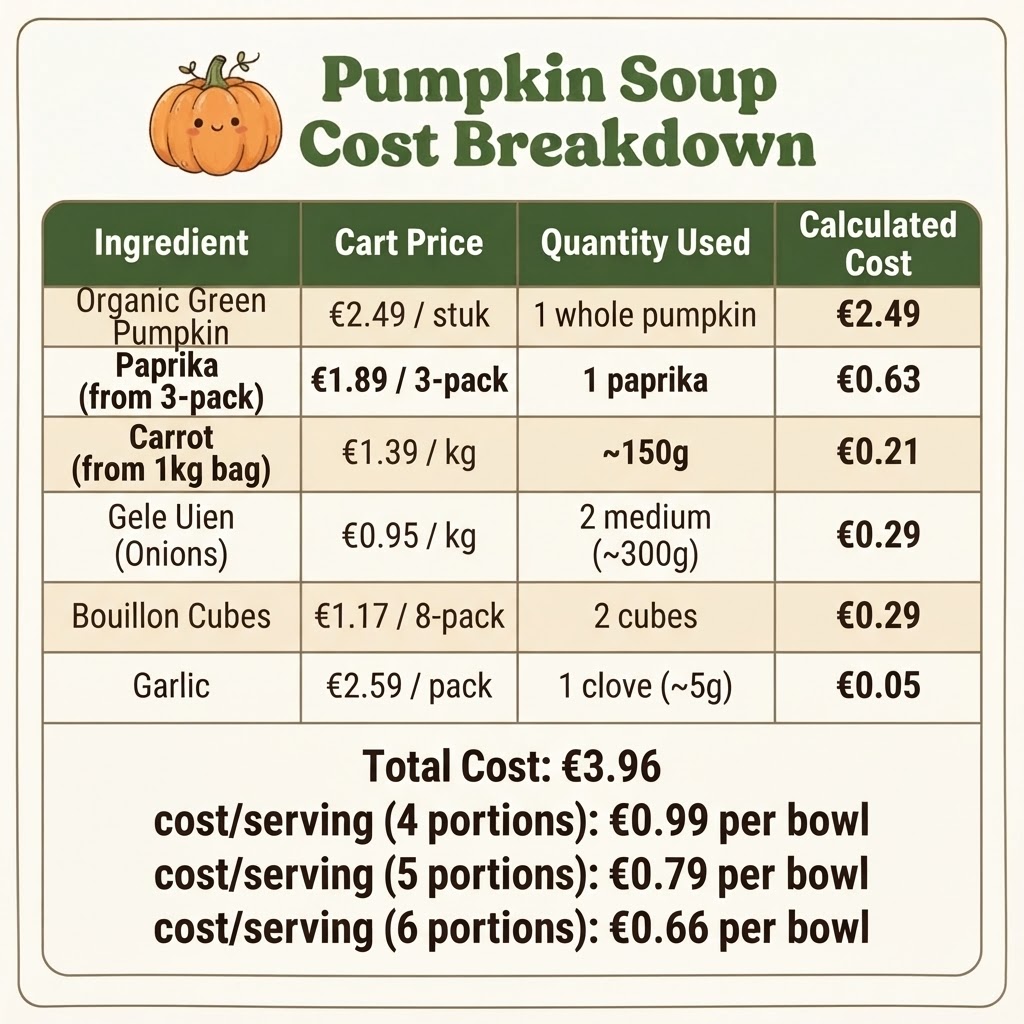
    So instead of buying the whole pre-packaged kit for €4.69, I decided to buy just the organic pumpkin on its own for €2.49. By skipping the pre-made bundle, I instantly kept an extra €2.20 in my pocket while using up leftover veggies we bought last week.

    Pumpkin Soup kit

    That is the exact philosophy of a No Buy Year – making things from scratch using what you already have instead of paying a convenience markup for plastic and cardboard.

    How to Make Simple Pumpkin Soup

    Ingredients You Need:

    • 1 pumpkin (chopped into cubes)
    • 2 onions & 1 clove of garlic (finely chopped)
    • 1 carrot (sliced into thin rounds)
    • 1 red bell pepper (cleaned and sliced into strips)
    • 2 vegetable or chicken bouillon cubes
    • 1.2 liters of water
    • a pinch of curry powder, salt, and pepper

    Optional twist: swap 200 ml of water for 200 ml of coconut milk if you want it extra creamy.

    Step-by-Step Instructions For a Simple Pumpkin Soup

    1. prep the veggies: give everything a good wash. For the pumpkin, there are couple methods how to cut it with more ease – look them up and pick your favorite.
    2. heat a couple of tablespoons of oil in a large soup pot. Toss in the cubed pumpkin, sliced carrot and onion. Stir on high heat for about 4 minutes.
    3. add garlic, a dash of curry powder and the bell pepper. Let it sit together for just 1 minute.
    4. pour in the 1.2 liters of water, crumble in your bouillon cubes and bring the whole thing to a boil. Turn the heat down low, pop the lid on, and let it simmer gently for 15 minutes until everything is fork-tender.
    5. take it off the heat and use an immersion blender to puree the soup until it’s completely smooth.

    The Real Cost Savings

    Sure, saving a couple of euros might not sound like a fortune on its own, but these micro-decisions add up massively over the course of a 365 days. Not only did I save money, but I also rescued the veggies sitting in my kitchen from getting forgotten (and rotting) in the back of the fridge.

    Complete shopping list for a pumpkin soup

    One thing that I should work on more is meal planning and meal prepping. We do it but sometimes we still waste food – maybe not as much as we used to – because we don’t get to use certain things up in time for them not to go bad. This was a perfect opportunity not to let it happen.

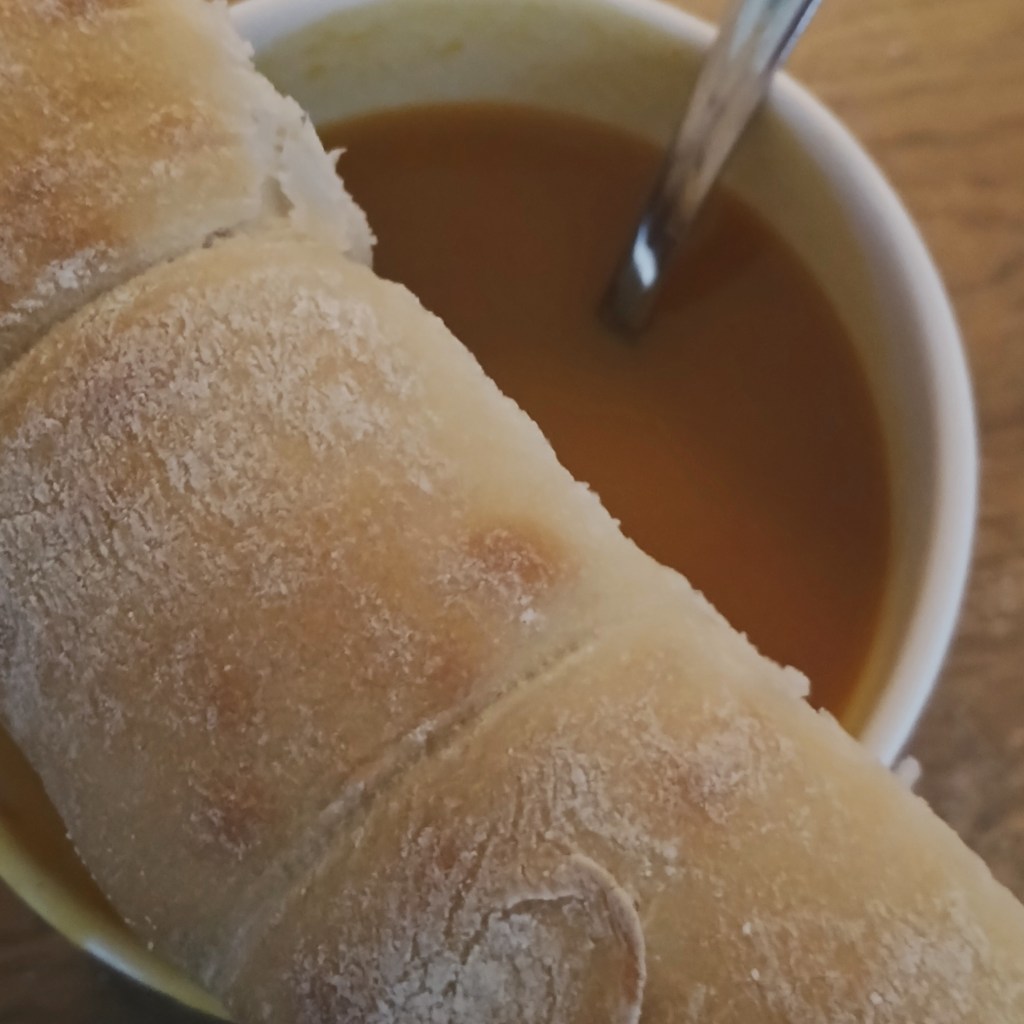
    Out of curiosity I decided to make some quick calculations and soup I made costs us 66 cents per serving (not including bread on the side).

    It was also a great occasion to try something new without spending a lot of money. Both me and my husband really liked it and I’m going to make this soup in the future for sure!

    Soups in general are very cost effective if you want to cook on a budget. If you get big packs of veggies that you can use in multiple dishes, it helps to save a ton. And aside from trying to figure out how to cut a pumpkin for the first time in my life (thanks, Google!), it’s very quick meal, that you can prepare in around 30 minutes.

    Have you ever tried one of those convenient meal kit? Or would you rather pick your own veggies? Did you find your new favorite dish this way? Let me know!

  • What I Wish My Younger Self Knew About Small Numbers
    Daily writing prompt
    What’s one thing you know now that would have saved your younger self a lot of pain?

    If you could sit down with your younger self for ten minutes, what would you tell them? You might warn them about a bad relationship, tell them to study a different subject or urge them to take more risks. For me, the conversation would start in a very unglamorous place: finances. Especially those small, unnecessary purchases – n overpriced snack at a vending machine at work, an energy drink on the way, that coffee after shopping or even small subscription fee for an app.

    When you’re young, broke and navigating your first real job, money often feels like something you don’t have (especially if you don’t come from a wealthier family and your first job is a low paying one) or can control. You may think financial ruin or success happens because of massive life events, like buying a car, getting a huge raise or making a terrible investment.

    What nobody tells you is that financial pain (and financial freedom) doesn’t sneak up on you. Doesn’t matter how much you earn, you control where your money is going. It might be easier if you have a higher salary, of course. But often our failure is connected to your daily habits and (lack of) planning ahead.

    I have to prefix this post with some information about me – especially if you just discovered my blog – I’m an adult in my 30’s who earns minimum wage. I come from a family who was drowning in debt when I was younger. Nobody taught me anything about finances (this topic was taboo in my home) and I had to figure out a lot of things on my own. So it’s not like I’m preaching about something I haven’t personally experienced.

    When I turned 18, I opened a bank account with a very expensive bank, just because my mother was banking there and she felt loyalty to whoever would borrow her money at the time… Because there was a balance requirement I couldn’t meet with my first job working customer service at a call center, I was paying a lot in fees, just to have an account in that bank.

    Right around the corner there was another bank that would charge me 0 (zero!) up until I was 26 years old, for an account with exactly the same functionalities. Financial literacy at its finest 👌🏻 🤣

    The Math of Micro-Spending


    Let’s look at a classic trap I fell into constantly as a young adult, who just started making my own money: buying a small treat at work because “it’s only 2 euros” and I didn’t bring lunch to work. That sounds harmless, right? It is just pocket change. But let’s look at what happens when it becomes a routine: 2 euros a day, 10 euros per week, 40 euros per month (let’s say we work 20 days per month, just for math’s sake). Not that much, right? Annually: 480 euros.


    Suddenly, that innocent little snack has cost you nearly 500 euros a year. And because it comes from the vending machine, we already know that its price is inflated enormously. If you sustained that habit for a decade, you’ve spent 4,800 euros on candy bars and chips. Not only unhealthy but also such a waste of money.

    Now, scale that up. Add the 4 euro coffee you grabbed because you were tired, the 15 euro dinner because you didn’t meal prep and you don’t have time to cook tonight. These tiny amounts leaving your wallet easily add up to thousands of euros a year.

    So whenever people make fun of avocado toast and take out coffee, I have mixed feelings. Yes, our generation has it more difficult that Boomers when it comes to crucial things in life, such as job security and housing. But when you are broke, you have to watch every cent. Make that avocado toast at home 😉


    The Power of Micro-Saving

    The cruel joke of compound math is that it works both ways. The exact same mechanism that drains your bank account can also build it.

    If only my younger self had taken that exact same 40 euros a month from the vending machine and invested it – or even just put it into savings account earning a modest return – the story would look entirely different.

    Instead of losing 4,800 euros over 10 years on snacks, redirecting that money into savings turns it into a growing asset. More importantly, it trains your brain. Saving isn’t about sacrificing all the joy in your life; it’s about recognizing the true value of your micro-decisions.

    One off purchase won’t do any harm. Making a habit out of it will. And as I’m sitting here trying to figure out how much margin for savings I have left after all of my expenses, it is clear that I simply cannot afford those small unnecessary purchases.

    It is frustrating, because I cannot save as much as I would like to (again, minimum wage) and I lost over a decade spending money on things that I did not need.

    One of the lessons I’ve learned is that you don’t need to completely overhaul your life overnight to see a change. You just need to become aware of the small, autopilot choices you make every single day.

    I would tell my younger self to budget and pay attention to everything that is going in and out. Don’t waste money on unnecessary things and fees. Temporary “sacrifice” is going to benefit us in a long run. I can see it now but I wished I actually understood it when I was in my 20’s.

    What is one small financial habit (good or bad) that took you years to figure out? Let me know!

  • How I Lower My Insurance Bills: The “Own Risk” Hack

    If you’re following along on my No Buy Year journey, you know I’m all about finding intentional, clever ways to slash monthly expenses without sacrificing my quality of life. End of the year is the time when discussion about healthcare insurance in the Netherlands starts all over again, because we can switch providers and adjust insurance policies.

    Today I’m going to share one way that I use to lower monthly expenses.

    The Strategy: Maxing Out My “Eigen Risico”

    In the Netherlands healthcare insurance comes with a mandatory deductible known as the eigen risico (own risk). By default, this is set at a baseline amount (which sits at €385), but insurance providers give you the option to voluntarily raise it in exchange for a lower monthly premium. You can also choose to have it at €0, by paying higher monthly contributions. The option you should choose highly depends on your health situation.

    For 2027, I’ve decided to max mine out to €900. Why would I voluntarily take on a higher deductible? Simple: I’m not chronically sick, and I very rarely visit the doctor. Because I don’t anticipate major medical expenses, it makes financial sense for me to bet on myself. The monthly discount on my premium adds up significantly over the course of the year, outweighing the baseline deductible (provided I stay healthy).

    Another way to get a little bit more of a discount is to pay your health insurance premiums once every quarter or make one payment per year. I personally don’t do that, because I’m currently not able to fork out entire amount. Would love to do that in the future though.

    But What If Something Happens? The Savings Plan

    Of course, maxing out your own risk means you have to be prepared in case the unexpected happens. If I do need medical care that falls under the deductible, I’m on the hook for that €900.

    Since I don’t have a separate, pre-existing savings account specifically for this goal, I’ve just set one up. To fund it safely without straining my budget, I’m going to put away €25 every single week (since I get paid weekly).

    It will take me exactly 36 weeks of consistent weekly transfers to fully fund my €900 buffer. Once I hit that 36-week mark, my eigen risico is completely covered, giving me total peace of mind for the rest of the year.

    Why This Fits the No Buy Philosophy

    A No Buy Year isn’t just about depriving yourself of shopping sprees. It’s about optimizing your fixed costs so your money goes toward things that truly matter. By lowering my monthly premium and systematically building a safety net €25 at a time, I get the best of both worlds: lower fixed monthly expenses and a fully funded medical buffer built painlessly over time (if nothing happens).

    I once heard that any form of an insurance is a gamble – you bet that something happens, your insurer bets the opposite. And I agree with that. So for 2027 I’m willing to take the gamble and try to lower my monthly expenses just a teeny tiny bit.

    If you are located in the Netherlands, do you play around with your deductible to lower your insurance premiums or do you prefer to stick to what is mandatory? And if you are in other countries – how do you lower your costs? Let me know in the comments below!
  • Project Pan: Empties no. 2

    My journey to declutter consists not only of getting rid of products by selling them on Vinted but also using up as much as I can during my No Buy Year. I have many beauty/skincare products that were just sitting in my stash. Slowly but surely I’m going through them.

    Today’s Project Pan empties update comes with a small win, even though I haven’t used up many products since my last post.

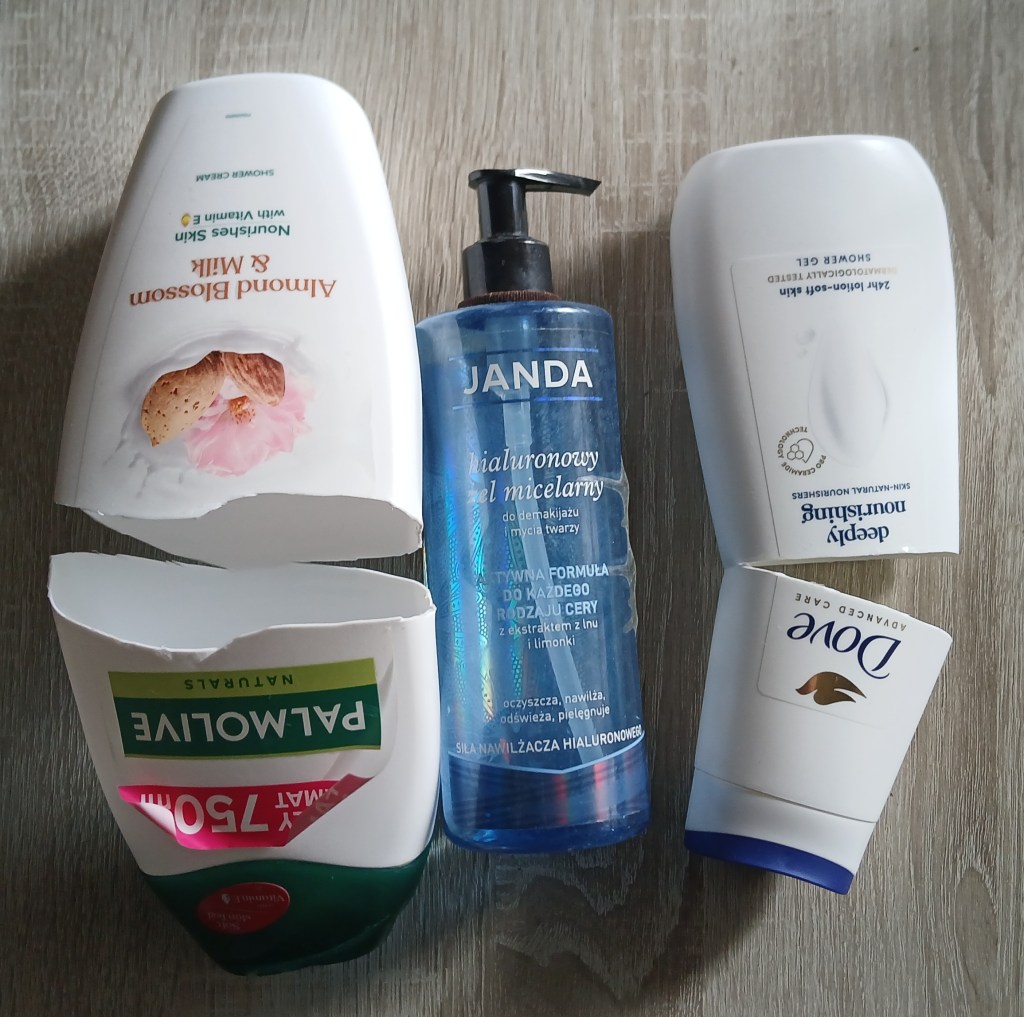
    Palmolive Naturals Shower Gel Almond Blossom & Milk Shower Cream – I bought it with my family coming over in mind. They have stayed for a week and I told them to pack light, because we will provide the basics, such as laundry and hygiene products. This bottle lasted me a long time. It was okay, nothing spectacular – I like creamy shower products. It is pretty basic but honestly, I don’t expect much more from a shower gel 😅

    Would I buy it again? Yes, sure, why not.

    JANDA Hyaluronowy Płyn Micelarny (Janda Hyaluronic Micellar Liquid) – unlike micellar water, this product has a gel consistency. Even though it’s not strongly perfumed, there’s a light citrus hint. Small amount goes a long way – and that’s my small win this time around, because I bought it in 2022 (I think), during vacation in Poland.

    I liked using it but it lasted me way too long – you can see the label peeling off from sitting in my shower.

    Would I buy it again? Yes.

    Dove Deeply Nourishing Shower Gel – it’s an okay shower product. I liked using it. I used to buy a lot of Dove products in the past. This particular one was a freebie with groceries over 35 euros at local supermarket, so I snatched it, as it is a very useful freebie.

    But when I saw “regular price”, I know that I wouldn’t buy it on my own. I don’t think it’s worth 10 euros per bottle…

    Would I buy it again? No, due to price.

    And that was it when it comes to empties update. I have some more products that I would like to use up in upcoming month, as we are preparing our big move. I really don’t want to haul many beauty products from one place to another… So stay tuned for the next update. I would like to finish more skincare products in October.

    Till next time,

    xoxo,

    Aleksandra

  • Wanting Less: The Most Underrated Life Skill for a No-Buy Year
    Daily writing prompt
    What’s the most underrated life skill?

    You just started your No Buy Year – you decided that financial health is more important than knick-knacks that clutter your home. It is an exciting and terrifying journey. You start with clearing out your shopping carts, unsubscribing from marketing emails and brace yourself for what a No Buy Year detox is going to bring your way.

    But as many participants discover, the real challenge isn’t avoiding stores – it is navigating the moments when the urge to buy flares up anyway, no matter what you do and how you prepare for that. In the end, we can justify any purchase we make. We have done it a lot in the past. And in modern age of Internet, we can shop 24/7.

    If you are looking for the ultimate superpower to carry you through a No Buy, the answer isn’t extreme budgeting or coupon clipping. Of course those skills can be useful to save money. But the skill I’m talking about today is something much deeper, because it depends greatly on your emotions.

    The most underrated life skill is the ability to deal with discomfort without trying to fix it with a purchase.

    Here is why this psychological muscle is your greatest financial asset not only during a No-Buy Year, but also when you’re done with the challenge. Mastering it will change your relationship with money forever.

    The “Retail Scratch”

    Modern consumerism has trained us to treat emotional friction like an emergency. Bored? Scroll an app. Stressed? Treat yourself to a little something. Anxious or lonely? Add to cart.

    We have weaponized retail therapy to scratch every psychological itch. Spending money provides a quick dopamine hit that temporarily numbs boredom, anxiety, loneliness, or frustration.

    When you start a No-Buy Year, you cut off that coping mechanism and suddenly, you are forced to sit face to face with your raw emotions. That sudden wave of restlessness or dissatisfaction? That is the discomfort we are talking about.

    Financial Superpower

    Learning to sit with discomfort without reacting to it transforms your finances because it breaks the loop of impulse buying.

    It builds resilience – instead of viewing discomfort as a crisis, you learn to see it as a normal, passing weather pattern in your mind.

    It stops emotional leakage – you stop spending money to solve non-financial problems (because a sweater cannot cure a stressful workday).

    It uncovers true values – when you stop using purchases as a distraction, you finally see what you are actually running from and what your actual needs are.

    3 Ways to Deal Discomfort During Your No-Buy Year

    Building this skill takes practice. It is very hard to find new coping mechanisms at the beginning. When the impulse to buy strikes, try these actionable steps:

    1. The 20-minute pause: when you feel a sudden urge to buy something, set a timer for 20 minutes. Do not try to distract yourself; just sit with the desire. Notice where you feel it in your body (tight chest, restless hands). Watch it rise, peak, and – usually – fade away on its own. You can also use the 48-hour rule to see if you really wanted that thing.
    2. Name the emotion – ask yourself what you are actually feeling. Are you stressed? Lonely? Procrastinating on a tough work task? Write it down in a notebook instead of making a purchase.
    3. Reframe the urge: treat the craving not as a deprivation, but as a workout for your self control muscle. Every time you resist the urge to buy something, you are strengthening your financial resilience.

    The Bottom Line

    A No Buy Year isn’t really about the things you aren’t buying – it is about the person you are becoming while you aren’t buying them. When you master the art of tolerating discomfort, you realize that you don’t need to consume to cope. If you stick to the rules and find other ways to cope (reading, making art, just taking a rest), you will transform your life.

    And don’t get me wrong, I know it’s hard to change habits, especially in the beginning. One misstep doesn’t cancel entire No Buy challenge. You should learn from it, not give up entirely. You can do this!

    What uncomfortable emotion do you find hardest to sit with without turning to shopping or scrolling?

  • How Easy Is to Go Without (Unnecessary Spending)?

    My perspective can be way different than that of someone who just started budgeting and living more mindful, as going without (unnecessary spending) is a muscle that we need to train. Even people like me – earning minimum wage – can struggle with just saying no to certain purchases. It is a process and at first it feels terrible. As I’m going through our apartment, trying to declutter as much as I can in upcoming two months, I’m realizing that we don’t have an income problem, we have spending and “usefulness” problem. Over the years we’ve accumulated a lot of things in different – non crucial – categories and we’ve kept those items because we might use them one day. As you can imagine, it became a problem to the point we had no space to store them. So we bought more furniture to be able to put away those items.

    I wouldn’t say it was a hoarding situation but it definitely wasn’t good for our mental health.

    My main struggle was (and still is) crafting supplies and beauty products. Crafting supplies are useful, especially if you DIY a lot, but I’ve realized that I have accumulated so much that it will last me a lifetime. That is why I sorted through most of it and sold off things that I bought ages ago and they were still in their original packaging. I mean, if I haven’t used it in 3 years, why would I keep it? Because I might one day?

    And when it comes to beauty products, I had a period of my life when skincare and make up was a coping mechanism. Then I stopped it all together, to the point that my current coworkers are shocked whenever I’m wearing any make up… Downside of having so many beauty products is that they are going to expire. That’s why I’m trying to sell off, donate and declutter things that I can, leaving only things that I know I can and will use up.

    Recognizing Unnecessary Spending

    I’ve shared with you two of my main struggle categories. For me it was easy to stop buying more of those items, simply because I saw how much I had. But unnecessary spending isn’t just accumulation per category – depending on your financial situation it can be anything outside absolute necessities, such as food, housing and bills. Everyone needs to decide for themselves what unnecessary spending means.

    One rule that a lot of people recommend is 48-hour rule. The 48-hour rule: Wait two days before buying any non-essential item. If you still want it and have a clear use for it, it’s likely a worthwhile purchase; if you’ve forgotten about it, it was unnecessary.

    I went one step further and entered a semi-emergency mode when it comes to my spending. Outside of necessary bills and weekly groceries, I don’t buy anything.

    At this point of my life saving is the most important thing I have to do. Of course situations where we need to get something happen but they are very rare – something breaks and we need to replace that thing. But outside of that, we can go without.

    So How Easy Is It to Go Without?

    At first – not at all. It takes time to build new habits and being able to say no, when your emotions say yes is a habit. After a while you start to ignore flashy advertising as if it didn’t exist. If it’s not in my budget and on my priority list, it doesn’t get much attention. It is a good feeling to be able to scroll past things that felt irresistible earlier.

    But taking the very first step can feel overwhelming. You can feel frustration or even anger and it is good to recognize that, as well as why you want that new thing.

    For some people avoiding certain stores will be beneficial. Others may way to physically walk away from their devices, if they struggle with online shopping.

    Your budget may allow for extra spending – it is important to have a budget and saving plan in the first place – but you still have to choose your priorities wisely and decide what is worth your money.

    As time goes on and you look around you, you learn to cherish things that you have and worked hard for. It is a process but it is totally worth it.

    Have you cut your unnecessary spending? Do you have any tips on how to do that? Share them in the comments below!

  • Self Care During a No Buy Year
    Daily writing prompt
    How do you make time for self-care?

    When people hear the words “No Buy Year,” their minds usually jump straight to financial discipline: budgeting, the strict shopping ban. But as I’m navigating my own no buy journey, I’ve discovered a plot twist – the hardest part isn’t saying no to the impulse buys; it’s unlearning the habit of using shopping as a form of self care.

    When your reward for a stressful day is adding unnecessary things your cart, removing it from your daily life leaves a gap. Been there, done that. So today I share my ways of protecting my peace and wellbeing without spending a single cent.

    Swapping “Retail Therapy” for Me-Time

    Let’s be honest: scrolling through online stores late at night only masquerades as “relaxing”. It feels productive when we find something we want but it often ends in buyer’s remorse. A lot of people cope with it by returning items, others shove them in the back of their closets… Now when I feel the urge to browse, I treat it as a sign that I am actually just tired, bored or overwhelmed. Instead of shopping, I carve out time for true rest: spending time on my balcony with a warm cup of tea, reading a physical book I already own or work on my crochet projects.

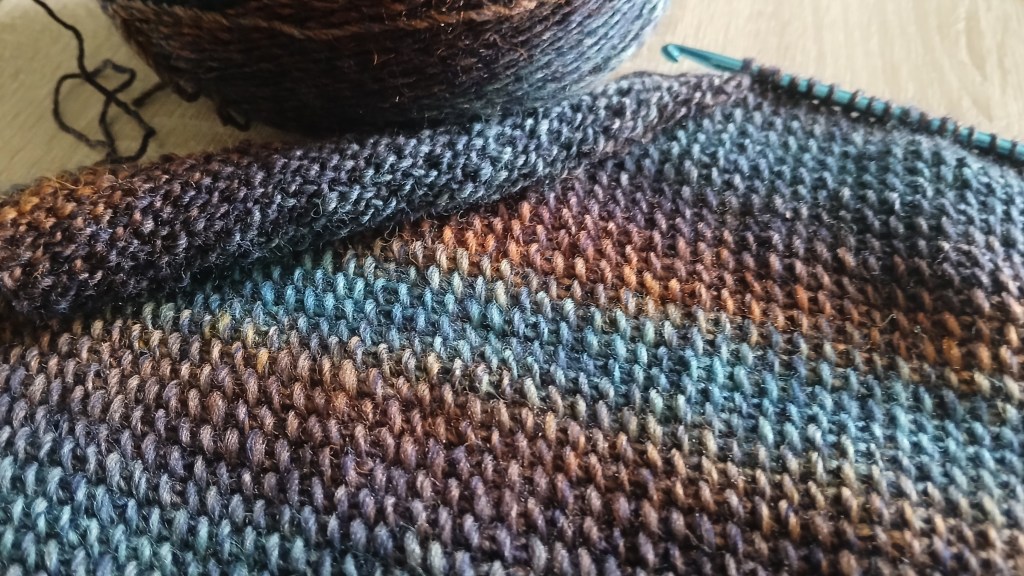
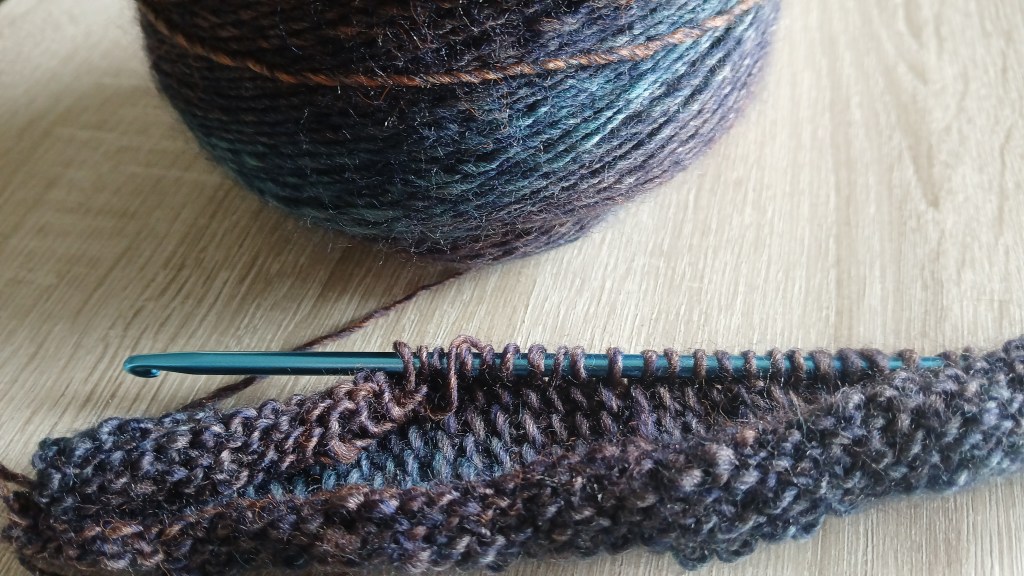
    This week I started a Tunisian crochet scarf from yarn that I bought years ago – I caught myself thinking that I should get something nicer for upcoming winter, as all my scarves have been to my work and don’t look the best anymore – I have mentioned my struggles with clothing in one of my previous posts. Instead of buying a new one, or even second hand one, I decided to use resources that I already have, save some money and keep my hands busy for hours, while I listen to my favorite podcasts.

    Guarding My Boundaries

    During a no-buy year, you quickly realize that your time and energy are finite resources, just like money. True self-care isn’t just about face masks and bubble baths – it’s about learning to protect your peace. I make time for self-care by treating my downtime as a non-negotiable. If I say “no” to an optional social obligation because I need a quiet evening at home, I don’t feel guilty about it. Of course some of my friends complain that I don’t go out or do fun things but preserving my mental bandwidth is the ultimate luxury. Sometimes I just cannot. Being able to recognize that and act on it is important.

    Finding Joy in What I Already Own

    Consumer culture tells us that self care comes in a package: a new bath bomb, a trendy planner or an expensive workout set. A No Buy Year strips away that illusion.

    Instead of acquiring new things to feel good, I’ve learned to actually use items I already have.

    My skincare routine consists of using every last drop of the products hiding at the back of my drawer. No need for new ones. I have accumulated so many beauty products over the years and none of them were a miracle that they promised to be. During my No Buy Year I want to significantly downsize my stash and ideally end up with one of each – a moisturizer, body lotion, make up remover. Keep it simple.

    I’m not 15-step-beauty-routine girl and I cannot buy like one.

    Reading books that I have accumulated and releasing them back to the world – having a home library is not my goal. Small bookshelf maybe. But I never really go back to read a book that I have already read. All they do is collect dust, after I put them back on the shelf. That’s why I list them on Vinted almost immediately after reading.

    Brewing coffee at home using my favorite mug. It tastes way better than any coffee I’ve ever bought.

    Taking care of yourself shouldn’t require tapping to pay. This year has taught me that real self-care is quiet, intentional and entirely free. It’s about listening to what my mind and body actually need – it could be a long walk or simply permission to do nothing at all.

    How do you carve out space for self-care in your daily routine, especially when life gets busy? Let me know in the comments below!
  • Saving…

    What’s one thing you wish you had started doing earlier in life?

    View all responses

    We all wish we would have done something earlier. As we get older and gain more experience in life, most of us think that if only we could go back to year xyz, we would change this, not make that mistake and our life would be different. It is partially true, as our life would be different but would we learn the same lessons?

    Importance of saving money has always been somewhere in the back of my mind. I grew up in a family that did complete opposite and at some point we were drowning in debt. Even though I knew I should be saving money, there was always something – I was earning too little, I needed to fix this, I needed to get that. So instead of taking small steps earlier, I’m taking small steps in my 30’s…

    First I needed to figure out where my money was going. Looking at the bank statements at some point made me realize that I had no excuse of earning minimum wage, if I was wasting money on unnecessary things and had no savings. Don’t get me wrong, buying something that is not absolutely needed to live is okay but doing it constantly and not having anything saved up for emergencies is not.

    Then I needed to figure out what I actually need to cover monthly – bills, insurance, phone plan, groceries. Doing those two things made me realize that I could save something. Maybe not hundreds of thousands of euros per month like some people are able to, but small amounts add up over time.

    That’s why I started this blog – a lot of people think that they’re absolutely screwed and cannot save because they earn very little. Sometimes that is true. But in many cases a little bit more focus on finances and being mindful about our habits and spending can make a difference.

    I wish I started saving money earlier but I also think that if I did, I wouldn’t have the need to be so vocal about it and start a whole No Buy Year blog. It is never too late though. My parents started turning their life around very close to retirement. I don’t want to be in their shoes though, with debt hanging over my head till I’m in my 60’s.

    Saving is not easy and won’t make you rich overnight. But if you are in your 20’s or early 30’s, there’s actually a chance that it will make your life easier and more comfortable later on. Not having to take on debt for emergencies or being able to cover certain things right away gives you freedom that is priceless. It is something to think about…

    Till next time,

    xoxo,

    Aleksandra

  • Project Pan: Empties no. 1

    ​During a No Buy Year I cannot forget about old-school challenge of Project Pan. Especially because I have a lot of skincare and make up products that I have purchased over the years and that are currently sitting in my stash. I would like to use as many of them as possible. I’m aware that some of them probably have expired by now, so this challenge and decluttering will be a great way to get rid of them and put overconsumption into perspective.

    Long time ago I realized that I really don’t need that many beauty products sitting on my shelves but I have been too overwhelmed to even try to go through them. But step by step we will get there!

    What is Project Pan?

    Project Pan first became popular in the online beauty community. “Panning” refers to the literal act of using a product completely until you hit the metal pan at the bottom of a powder product, for example an eyeshadow. It is a challenge where you select a specific group of items – it could be makeup, skincare, haircare or other household goods – and commit to using them up before purchasing any replacements. This way you actually use what you have.

    Empties no. 1

    In this post I will share my first empties during my No Buy Year. They’re not as impressive as I would like them to be but finishing products is a process and it takes time!

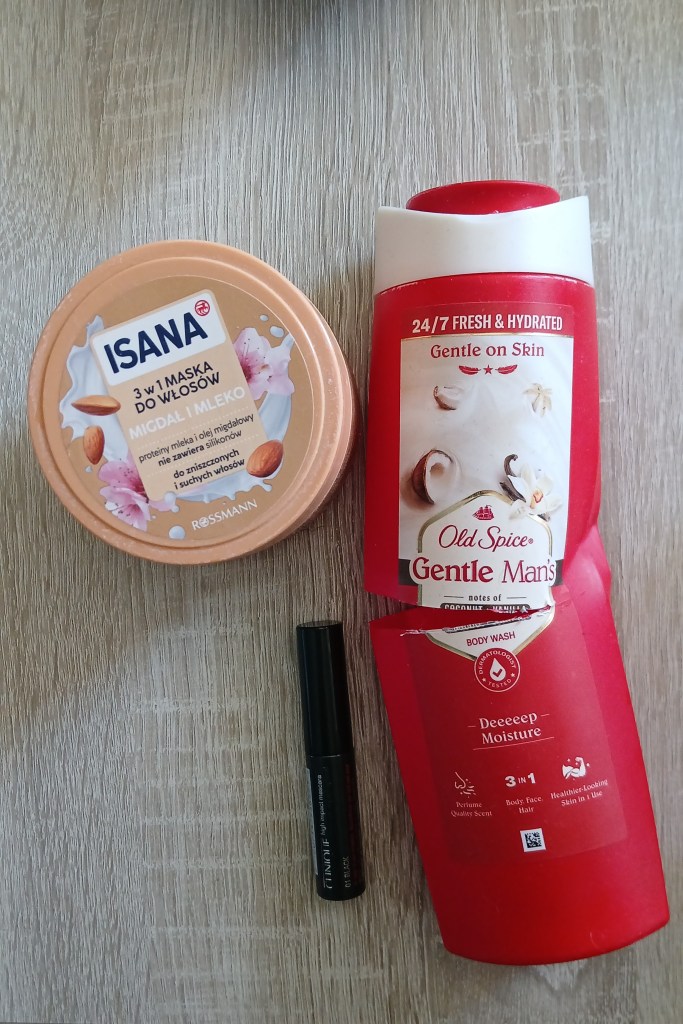
    This time I have finished 3 products:

    ISANA 3 in 1 Maska do Włosów (Migdał i Mleko) – a 3-in-1 hair mask with almond and milk protein by Rossmann. I really liked this hair mask – the smell and how this product worked is just perfect. Helped me a lot when I had to detangle my hair. For some reason (probably because I cannot get it in my country) I was “saving” it for later and using it sparingly. But now it’s gone! Yaay!

    Would I rebuy it if I didn’t have similar product in my stash? Yes!

    Old Spice Gentle Man’s Body Wash (Deeeeeep Moisture) – a 3-in-1 body wash, face and hair product with notes of coconut and vanilla. Family member left it in my shower when they visited us. We won’t see each other for months, so I decided to finish it, even though it’s a product dedicated to men. The scent wasn’t something that I would say only men can use, so it wasn’t that obvious that I was using men’s body wash.

    I had to cut through the packaging to get the rest of it out and there was significant amount left!

    Would I rebuy it? Technically I didn’t buy it in the first place. But I wouldn’t buy it for me or my husband.

    Clinique High Impact Mascara – this one wasn’t really an empty-empty. I have used it before and liked it, so I got a new one, but this time it was giving me a lot of trouble with itchiness after a while, so I decided to stop using it after trying to make it work…

    I don’t have a strict list of products to finish in my Project Pan challenge. I want most of them gone but I’m aware it will take me a long time. If you would like to follow my journey, please consider subscribing to this blog.

    I also stopped wearing make up as much as I did years ago – I can count times I wore it this year on my fingers – so I need to figure out a way to start all over again.

    Good thing for my No Buy Year is that even if I get into doing make up again, I won’t be buying new things any time soon. I’m currently discovering my stash all over again and honestly, it feels like shopping.

    I cannot sell or give away much of my collection, as those things have been opened and used at some point. For hygienic reasons it’s not a good idea to find them a new home and I would like to avoid throwing out as much as possible…

    Are you currently participating in a Project Pan? Or have you in the past? What are your thoughts about this challenge? Let me know!

    Till next time,

    xoxo,

    Aleksandra